
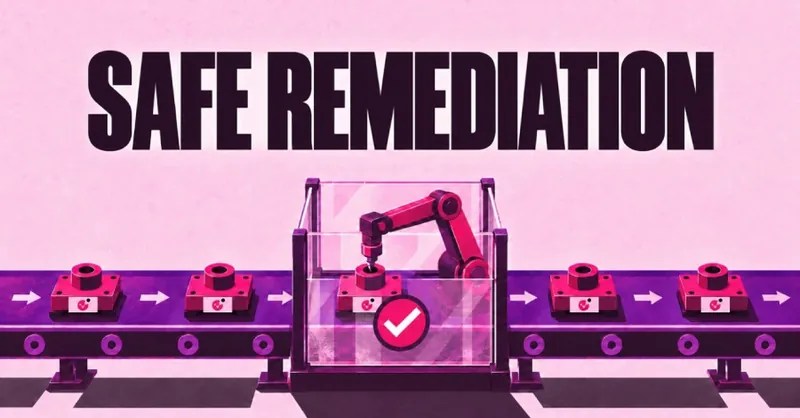
What the framework proposes
The original Hacker News article presents Safe Remediation as four stages: Observe, Prove, Act and Confirm. It describes validating a change against the affected environment, approving its scope, executing it and checking the result.
The article is labelled a contributed partner piece and discusses Check Point Exposure Management. Its reported outcomes should be read in that context. Firstnews has not independently evaluated the underlying white paper’s sample or reproduced its results; the earlier unqualified survey statistic has been removed.
Illustrative evidence checklist
This is a proposed change record, not an account of a test performed by this publication.
| Record | What to capture |
|---|---|
| Current state | The affected service, exposure and existing control state. |
| Test scope | Which hosts or traffic are included, and why the sample is relevant. |
| Observations | The expected result, false positives and any service impact. |
| Approval | The accountable owner, agreed scope and scheduled action. |
| Rollback condition | The observable failure that triggers a reversal or escalation. |
| Confirmation | What actually changed, what remains pending and who checked it. |
The checklist does not define a universal acceptable error rate or test duration. Those depend on the service, control and change process. Approval should identify the evidence used rather than assume that a named framework makes the change safe.
Track interim and permanent fixes separately
The source distinguishes temporary protection from remediation of the underlying vulnerability. A virtual patch or other compensating control may reduce exposure while the permanent fix is still outstanding. The change record should keep that outstanding work visible.
Correction, 31 October 2026: Added source attribution and a clearly labelled illustrative checklist. Removed the unsupported claim that the example completes within hours, unqualified survey precision and guaranteed speed or disruption benefits.
Related operational coverage
Add exploitation evidence to the change record
CISA's official KEV data repository provides a dated catalogue and schema. When using it, save the catalogue version and the specific CVE entry alongside the vendor advisory; it is not a scan of your environment.
Add three fields to the checklist above: the exact deployed product/version, the evidence supporting exposure, and the verification performed after the change. If a host has not been checked, retain that outstanding item rather than marking the entire change complete.
The vulnerability worksheet keeps advisory scope, reported exploitation, mitigation and post-change confirmation separate. A news mention or an absent catalogue entry is not a verdict on whether a particular host is affected.
Update, 31 October 2026: Added a primary catalogue reference and explicit asset-level confirmation fields; no deployment outcome is asserted.