
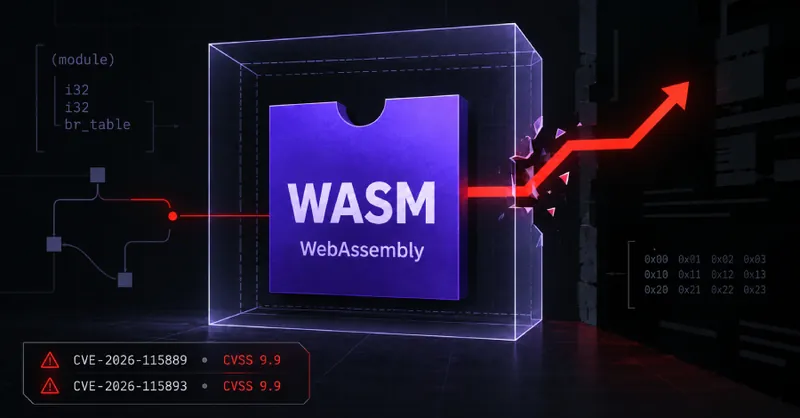
Wasmtime Sandbox Escape Vulnerabilities Exposed
On October 19, 2026, the Bytecode Alliance released advisories for two critical CVEs that affect the Wasmtime WebAssembly runtime. CVE-2026-115889 is a buffer-overflow flaw that is architecture-agnostic, while CVE-2026-115893 is limited to ARM64. Both flaws allow a malicious WebAssembly module to escape the sandbox and execute code in the host process.
The advisories list the affected versions as all releases prior to 36.0.19, the 37-42.x series, and the 43-47.x series on ARM64. The recommended mitigation is to upgrade to 48.0.7 or later, which contains the necessary bounds-checking patches.
Attack Path and Technical Details
The Wasmtime runtime compiles WebAssembly modules to native code using the Cranelift compiler. In the vulnerable versions, Cranelift’s bounds checking logic fails to validate the size of a memory access when the module performs a load or store operation that crosses a page boundary. An attacker can craft a module that triggers this overflow, causing the runtime to read or write memory outside the allocated sandbox.
Because Wasmtime is used in a variety of contexts—edge computing, serverless functions, and embedded devices—the impact of a sandbox escape is broad. A compromised module could read sensitive data from the host, modify configuration files, or execute arbitrary binaries.
Evidence and Source Context
The advisories were published on Oct 19–20, 2026, and include detailed exploit code snippets. The Bytecode Alliance notes that no exploitation has been observed in the wild as of Oct 26, 2026. However, the presence of the flaw in widely deployed versions—such as the 36.x series used by several cloud providers—means that the risk is real.
The advisories also reference a prior issue in Cranelift’s bounds-checking routine that was identified in 2025. The 2026 CVEs build on that earlier problem, indicating a pattern of insufficient memory safety checks in the compiler backend.
Immediate Mitigation Steps
- Inventory – Identify all instances of Wasmtime in your environment. Check the version string exposed by the
wasmtime --versioncommand or by inspecting the package metadata. - Upgrade – Replace vulnerable binaries with 48.0.7 or later. For containerized deployments, update the base image to the latest tag.
- Validate – Run the
wasmtime --checkcommand on a known safe module to confirm that the runtime no longer accepts malformed memory accesses. - Audit – Review any custom WebAssembly modules that are compiled at runtime. Ensure they are signed or otherwise validated before execution.
- Monitor – Enable runtime logging for memory access violations. Look for patterns that match the exploit signatures described in the advisories.
What to Watch Next
The dual-flaw pattern suggests that other components of the Wasmtime toolchain may contain similar bounds-checking gaps. The Bytecode Alliance has issued a follow-up advisory for a third CVE (CVE-2026-115897) that affects the host-side API on x86-64. Organizations should monitor the Bytecode Alliance’s release stream for additional patches.
In the meantime, any service that compiles untrusted WebAssembly code—such as a public API that accepts user-supplied modules—should consider disabling dynamic compilation or sandboxing the runtime in a separate process.
Related Coverage
- OVHcloud GitHub Compromise Reveals GlassWorm Activity
- North Korea Targets Ukrainian Personnel with Reply-Bait Phishing