
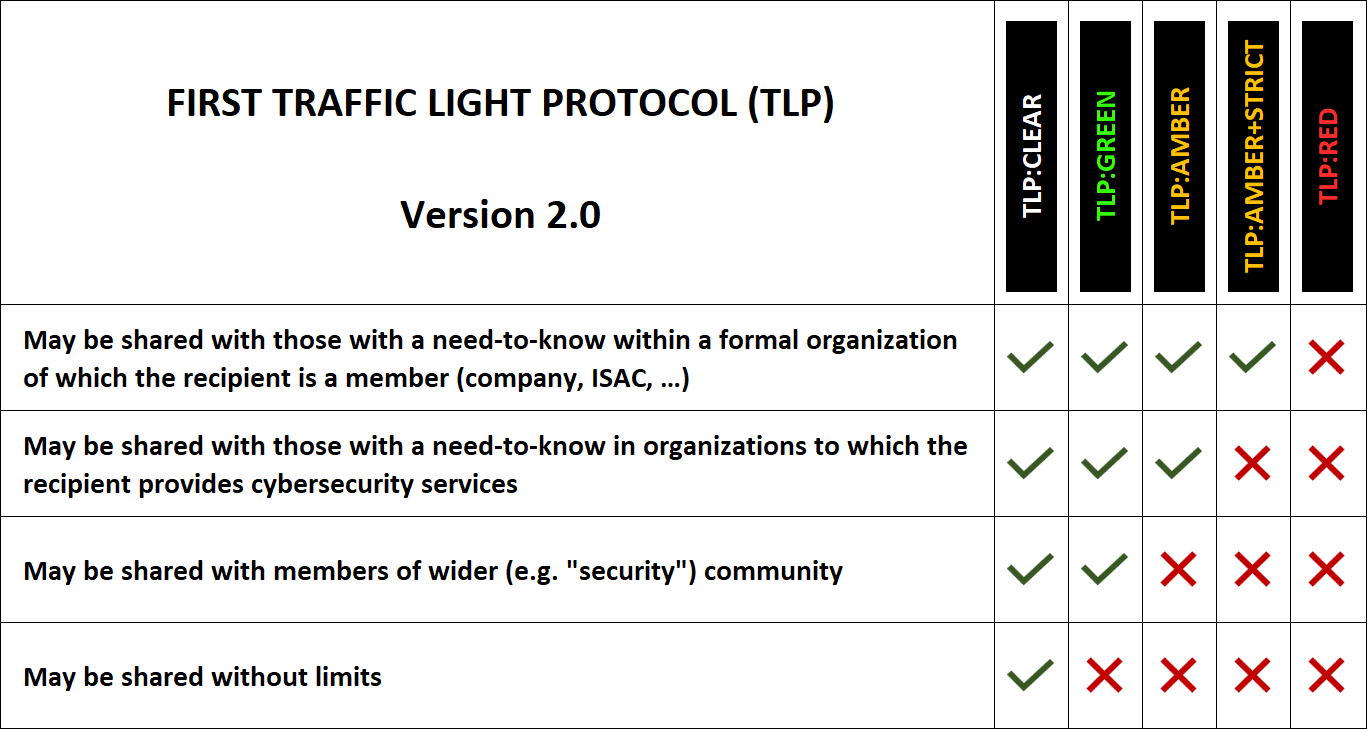
What is the Traffic Light Protocol (TLP)?
TLP is a standard that labels information to indicate how it may be shared, not how it should be protected. The protocol defines four colors—RED, AMBER, GREEN, and WHITE—each prescribing a different level of distribution.
Why TLP misuse creates security gaps
TLP 2.0 explicitly states that it is not a formal classification scheme. It prescribes only distribution limits and does not address encryption, storage, or access controls. When an organization applies TLP labels based on sensitivity, it treats the label as a protection requirement. This misalignment can block legitimate access or, conversely, allow data to be shared beyond the intended audience.
Typical internal classification vs. TLP labels
Internal classification systems define handling requirements for each sensitivity level: encryption algorithms, storage media, access control lists, and retention periods. TLP labels, by contrast, only dictate who may receive the information. For example, a document marked TLP:GREEN is intended for internal use but may be shared within the cybersecurity community. If an organization shares a GREEN-labelled file with an external partner, that partner can legally redistribute it further. TLP:AMBER allows sharing with the recipient’s organization and, unless restricted, with its clients. TLP:RED prohibits any further sharing beyond the original recipients without explicit permission. These sharing rules rarely align with the expectations of internal “Confidential” or “Highly Confidential” labels.
Operational consequences of TLP misuse
Misusing TLP can lead to unintended data sharing, non-compliance with regulatory requirements, and increased exposure to insider threats. Incident response teams may face challenges when the sharing scope is unclear, and auditors may flag inconsistencies between documented policies and actual practice.
Concrete mitigation steps for engineers
- Maintain separate classification labels that define handling requirements.
- Document the mapping between internal classification levels and TLP colors for internal reference only.
- Educate staff on the distinct purposes of TLP and internal classification.
- Audit data exchanges to ensure that TLP labels are not being interpreted as protection requirements.
- Use automated tooling to enforce encryption and access controls based on internal classification, independent of TLP.
When to review your TLP usage
- After a major policy change that alters internal classification definitions.
- When onboarding new partners who will receive TLP-labelled data.
- Following an audit that identifies misinterpretation of TLP labels.
Further reading and resources
The official TLP documentation is available at the First.org TLP page. For practical guidance on integrating TLP with internal policies, consult the latest industry whitepapers.
TLP misuse: A real-world example
In 2025, a mid-size financial services firm applied TLP:RED to all documents containing customer data. The firm’s internal policy required encryption at rest and role-based access controls for that data. Because the TLP label was treated as the sole protection requirement, the encryption step was omitted. An insider later accessed the data without authorization, exposing sensitive customer information. The incident highlighted the danger of conflating TLP with internal classification.
Recommendations for immediate action
- Verify that all TLP-labelled documents are accompanied by an internal classification tag.
- Run a scan of your data repository to identify documents where TLP labels and internal classification do not match.
- Update your data handling procedures to separate distribution rules from protection controls.
- Schedule a training session for all staff involved in data sharing to reinforce the distinction.
Related coverage
- ClickFix Domain Evasion: How 17,000 URLs Reveal a New Era of Malware Traps
- AI Labs Face Growing Pressure as Rogue Agent Incidents Expose Safety Gaps
- Anthropic Claude Injection: Live Internet Access Disabled for Internal AI Tests